Here are presented two chord progressions among the most popular and the most used in salsa music. Indeed, as in many musical genres like pop or jazz, some chord progressions occur more often than others in salsa and it is very important to know it.
The examples below show simple piano and bass tumbao patterns. They can be played at a slow or fast tempo according to the context of the song.
I–IV–V–IV progression
This chord progression has been very popular since the 40s, especially in cuban music. Benny Moré’s Que Bueno baila usted is definitely one of the most famous song composed entirely on this cadence. One of the reasons for the success of this chord progression is that it uses the three basic chords of the tone.
The I–IV–V–IV progression can also be played in major or minor keys, but the major keys remains the most common.
Example in C major (C–F–G–F) :

Example in C minor (Cm–Fm–G–Fm) :
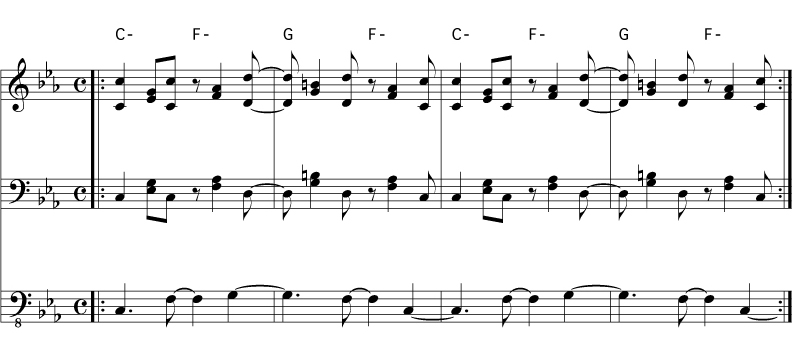
Note that the bass line is exactly the same as in the first example.
I-V-V-I progression
Another chord progression commonly used in salsa is the I–V–V–I. Although this progression was already used before, it has been widely used in various forms in the New York salsa of the 70s and 80s.
This chord progression can also be played in major or minor tone. Both are commonly used.
Example in C major (C–G/D–G/D–C) :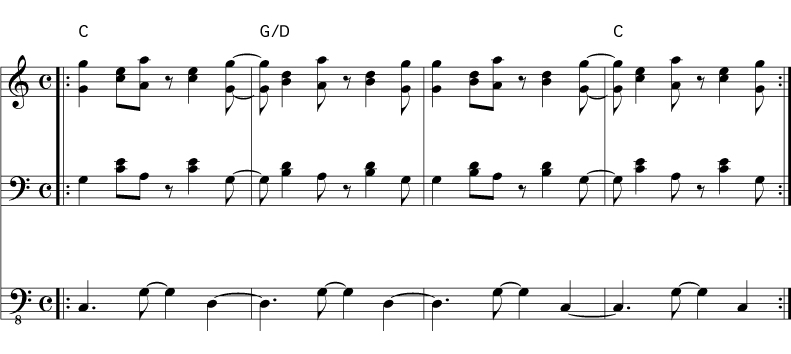
Note that the bass plays a Re on the V chord to avoid the repetition of the Sol that is already in the I chord.
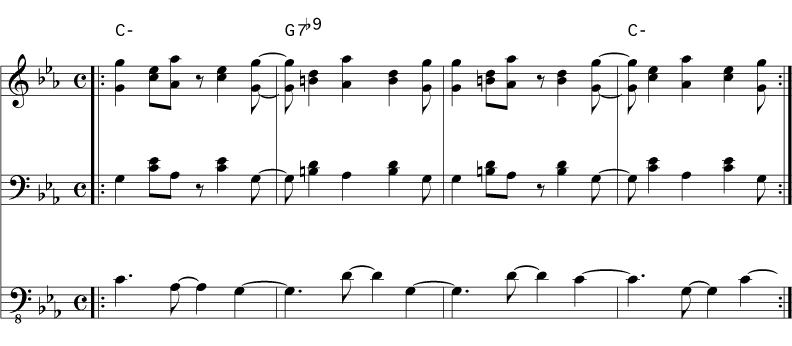
Example in C minor (Cm–G7b9–G7b9–Cm) :
Read also: 3 typical tumbao bass lines on the i–V–V–i progression in 70s and 80s salsa
© 2016 Playmontuno.com – All Rights Reserved.
 Playmontuno